
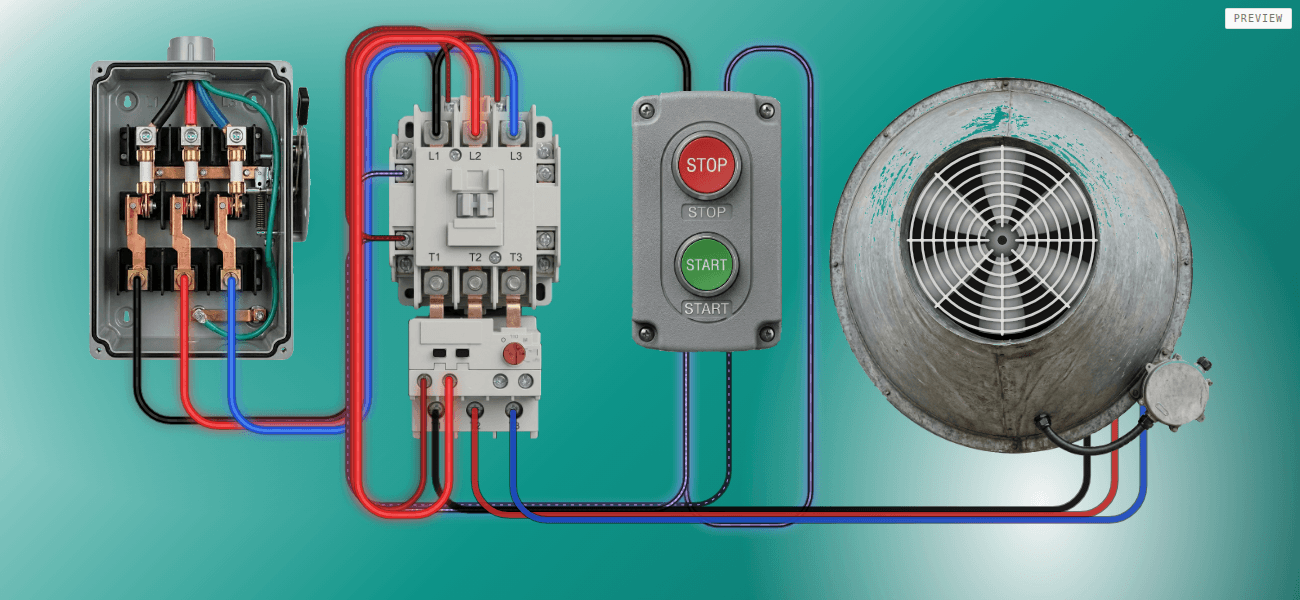
A motor starter is a device that combines a contactor (for switching the motor on and off) with an overload relay (for protection against sustained overcurrent). A motor control simulator is a browser trainer where you wire an industrial control circuit terminal by terminal and energize it the way you would on a panel. Electrimancer runs the basic motor starter free with no account — route the cables, press START, and trace voltage when nothing happens.
You can memorize the 3-wire control path — L1 through the STOP contact, through START, through the coil, through the OL contact, back to L2 — and still not know what happens when someone lands the STOP button on an NO contact instead of NC. That understanding comes from wiring the circuit yourself, pressing START, watching nothing happen, and tracing voltage until you find the break.
Training panels exist for this, but they are a shared resource. Shops run one or two across shifts. Community colleges share them between class sections. A maintenance tech picking up controls on their own time may not have access to one at all. A motor control simulator puts the same terminals in your browser — wire between them, make the same mistakes, trace the same voltages — on whatever schedule works.
How Each Trainer Runs
Every circuit starts the same way: lesson, wiring, commissioning. What comes after depends on the trainer.
The lesson builds the circuit wire by wire — each connection named and justified before you pick up a wire yourself.
During wiring, you connect the circuit from scratch. Wires route through cable ducts. A live ladder diagram shows which connections are complete and which are missing.
Commissioning walks through the start, stop, and overload sequences that confirm each protection and control function works.
After commissioning, the basic motor starter and the reversing hoist run troubleshooting: injected faults — a stuck-open contact, a broken wire, a tripped overload — that you diagnose with a digital multimeter. No instructions at this point. You reason about the circuit. The control transformer and both jogging trainers run explorations instead: guided variations that extend the working circuit, like sizing the transformer's fuses per NEC 430.72(C) or wiring pilot-light indication off the auxiliary contacts. The VFD retrofit gets both.
Every trainer closes with a final test. Pass it and the module's badge goes on your record.
The Trainers
The basic motor starter is the standard 3-wire start/stop circuit. Every other trainer builds on the concepts introduced here. Covers both NEMA and IEC overload relay placement. Five troubleshooting scenarios. Before wiring, read how to wire a motor starter and what's already wired inside your motor starter. Free, no account needed.

Reading is one thing — wiring it yourself is another. Open the interactive trainer and build this circuit from scratch.
Start wiring — free, no account needed →The control transformer starter separates control voltage from motor voltage. A step-down transformer provides 24V for the control circuit while the motor runs at 208V. Covers primary/secondary wiring and fuse sizing per NEC 430.72(C). Standard practice at 480V, increasingly common at 208V.

Reading is one thing — wiring it yourself is another. Open the interactive trainer and build this circuit from scratch.
Try the control transformer trainer →The selector switch jog circuit uses a maintained selector switch to choose between continuous RUN and momentary JOG. In JOG position, the seal-in contact is mechanically disconnected — the motor runs only while START is held. Includes a pilot light exploration for wiring NO and NC auxiliary contacts.

Reading is one thing — wiring it yourself is another. Open the interactive trainer and build this circuit from scratch.
Try the selector switch jog trainer →The control relay jog circuit uses a DPDT control relay to isolate the jog path from the seal-in. Two explorations remove the control relay and show the simpler configurations that don't need it: two-location start/stop and two-location jog-only.

Reading is one thing — wiring it yourself is another. Open the interactive trainer and build this circuit from scratch.
Try the control relay jog trainer →The reversing hoist starter uses two contactors with electrical interlocking to prevent simultaneous engagement. Covers phase swapping for motor reversal, interlock wiring, upper and lower limit switches, and a 24V control transformer. This one brings together everything from the previous four.

Reading is one thing — wiring it yourself is another. Open the interactive trainer and build this circuit from scratch.
Try the reversing hoist trainer →The VFD retrofit swaps the contactor logic for an Allen-Bradley PowerFlex 525. You wire the drive's power and control terminals — a maintained run toggle, a FWD/REV selector, a remote speed potentiometer, Ready and Fault pilot lights — then the logic moves out of the copper: motor nameplate data and command sources get keyed in through the drive's own keypad before you commission each function. Troubleshooting covers latched drive faults, parameters pointed at the wrong source, and open control wiring.

Reading is one thing — wiring it yourself is another. Open the interactive trainer and build this circuit from scratch.
Try the VFD trainer →Build Your Own Circuit
Every trainer above puts you inside one circuit, moving through the lesson, wiring, and commissioning sequence described earlier. The Sandbox Workbench drops that structure. It opens to an empty bench and a palette of more than twenty components — starters, motors, relays, timers, pushbuttons, pilot lights — with no required circuit and no wiring sequence. You decide what to build and where the wire runs.
Building and saving a circuit in the Sandbox Workbench takes a Pro account. What you save stays there to open and revise later. A finished circuit can also go out as a share link. Anyone who opens it can power the bench and operate it — no account required. Creating the link takes a Pro account; operating what's behind it doesn't.
A training director sketching a fault scenario for class, or an electrician working out an unfamiliar circuit before running it at the shop, gets the same terminals and the same meter with no curriculum attached.
Reading is one thing — wiring it yourself is another. Open the interactive trainer and build this circuit from scratch.
Open the Sandbox Workbench →Getting Started
The basic motor starter is free and needs no account. Open it, go through the lesson, wire the circuit. Lesson through your first troubleshooting scenario takes about 30 minutes.
Reading is one thing — wiring it yourself is another. Open the interactive trainer and build this circuit from scratch.
Start your first circuit — free →Frequently asked questions
What is a motor control simulator?
A browser-based trainer where you wire industrial motor control circuits from scratch. You connect terminals on a contactor, overload relay, control station, and motor — wires route through cable ducts, a ladder diagram updates live, and a digital multimeter lets you trace voltages the way you would on a real panel. Mistakes produce wrong circuit behavior, not a hint.
Is Electrimancer free to use?
The basic motor starter — lesson, wiring, and commissioning of a 3-wire start/stop circuit — is free with no account required. Troubleshooting scenarios, explorations, the final test, and the five advanced trainers (control transformer, selector switch jog, control relay jog, reversing hoist, variable frequency drive) require a Pro account at $15/month or $129/year. A free account unlocks the mentor on the basic trainer with five lifetime messages.
What circuits can you build in Electrimancer?
Six circuits. Basic motor starter (3-wire start/stop, NEMA and IEC OL placement), control transformer starter (24V control separate from 208V motor circuit), selector switch jog (RUN/JOG selector gating the seal-in), control relay jog (DPDT relay isolating the jog path), and reversing hoist (forward/reverse contactors with electrical interlocking, limit switches, 24V control transformer), and a variable frequency drive (Allen-Bradley PowerFlex 525 driving a rotary lobe pump — analog speed control, digital start/stop, forward/reverse, and drive-parameter programming). Beyond these six, the Sandbox Workbench lets a Pro account build and save circuits from an open component palette with no fixed lesson.
How does the mentor work?
It tracks the state of your circuit — which wires are connected, which terminals are energized, which contacts are open or closed — and gives targeted guidance without giving away the answer. Wire something wrong and it asks you to think about what is missing rather than telling you where to put the wire. It never sends unsolicited messages. You ask, it responds.
Can you build your own circuit instead of following a guided trainer?
Yes. The Sandbox Workbench opens to an empty bench and a palette of more than twenty components: starters, motors, relays, timers, pushbuttons, pilot lights. There is no prescribed circuit — you place components and route wire the way you want. Building and saving requires a Pro account ($15/month or $129/year). A finished circuit can go out as a share link, and anyone who opens it can power the bench, press the buttons, trip the overload, and read the multimeter without an account. Creating the share link is a Pro action; operating what's behind it is not.
Is there a motor control simulator app or download?
No. Electrimancer runs in the browser, with no download and no app to install. The basic motor starter trainer is free with no account, and on a phone it opens as a guided wiring challenge instead of the full desktop bench. The other five trainers are desktop-only and open in the same browser tab. Bookmark the page; there is nothing to update or reinstall.
How long does a circuit trainer take to complete?
The basic motor starter — lesson, wiring, and commissioning — runs about 20 minutes on a first pass. Advanced trainers take longer because the circuits are larger and the troubleshooting and explorations add depth. The reversing hoist brings together concepts from all previous trainers and runs the longest.