
Every jogging circuit, reversing starter, and multi-speed controller in industrial motor control is a variation on the same underlying topology. Three wires run between the control station and the motor starter — one for STOP, one for START, one common return — and the logic they create is the reason a 50-horsepower conveyor belt doesn't restart itself after a power outage.
That logic is the 3-wire control circuit.
The Name
The "3-wire" designation distinguishes this circuit from 2-wire control, where a single maintained device — a thermostat, float switch, toggle, or pressure switch — directly controls the contactor coil. Two conductors run to the device: hot and return. The motor runs whenever the switch is closed and stops when it opens.
2-wire control works for equipment where an unattended restart is acceptable or even desirable. A sump pump should resume pumping when power returns. A walk-in cooler compressor should resume cooling. The maintained switch holds the state — no human intervention required.
The problem appears when an unattended restart is dangerous. A conveyor belt, drill press, lathe, or air compressor that resumes operation after a power interruption can injure or kill someone standing in the wrong place. 2-wire control has no mechanism to prevent this. If the switch is closed and power returns, the motor starts.
3-wire control solves this by adding memory to the circuit. The circuit latches itself on when told to start, and it forgets on power loss. The mechanism is entirely electromechanical — no electronics, no programming, no battery backup. One auxiliary contact, wired in parallel with the START button, does the entire job.
Three States, Three Current Paths
The circuit has exactly three operating states. Each one has a distinct current path through the control circuit.
At Rest
The circuit is waiting. No current flows.
The STOP button is normally closed — a continuous path exists through it. The START button is normally open — the path is broken here. The contactor coil is de-energized. The seal-in auxiliary contact (NO, terminals 13-14) mirrors the contactor state: open. The overload relay contacts (NC, terminals 95-96) are closed — no fault condition exists.
Current cannot flow because the open START button breaks the series path between L1 and the coil. The motor is off.
Running
The motor is running and will stay running until something breaks the control path.
Current flows from L1 through the closed STOP button, through the closed seal-in contact (bypassing the released START button), through the contactor coil (A1 to A2), through the closed OL contacts (95 to 96), and back to L2.
The START button has been released — it returned to its normally open position — but the circuit no longer needs it. When the contactor pulled in, the seal-in auxiliary contact closed, creating a parallel path around the START button. This is the latch. The circuit holds itself on through its own auxiliary contact.
Stopping
Someone pressed STOP, or the overload relay tripped, or the facility lost power.
The NC STOP button opens, breaking the series path. The coil de-energizes. Every contact driven by the contactor opens simultaneously: the three main power contacts (motor disconnected), the seal-in auxiliary (latch released). The OL contacts remain closed unless the OL tripped.
The circuit returns to its resting state. Releasing the STOP button — which springs back to its normally closed position — does not restart the motor. The seal-in contact is open. The START button is open. No current can flow until someone deliberately presses START again.
This is low-voltage protection: the circuit's memory is stored in the seal-in contact, and that contact is driven by the coil, and the coil requires continuous current to stay energized. Remove power for any reason and the memory clears.
Press the buttons below and watch the current path change through the ladder diagram:
Instrument: 3-Wire Control Logic
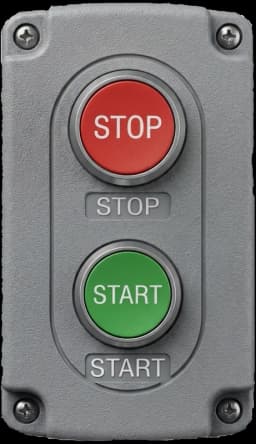
Physical Interface
2-Wire vs 3-Wire
| 2-Wire Control | 3-Wire Control | |
|---|---|---|
| Control device | Maintained switch (toggle, thermostat, float) | Momentary pushbuttons (START/STOP) |
| Memory mechanism | None — switch position is the state | Seal-in auxiliary holds the latch |
| Low-voltage protection | No — motor restarts on power return | Yes — requires deliberate START press |
| Conductors to control device | 2 (hot + return) | 3 (stop + start + common) |
| Typical applications | HVAC blowers, sump pumps, unit heaters | Conveyors, machine tools, compressors, hoists |
Neither topology is universally superior. The distinction is whether an unattended restart after power loss is acceptable for the application. When it is not, 3-wire control is the standard.
Turn on both circuits below, then hit Power Loss and watch the difference:
Instrument: Comparison Analysis
2-Wire Control
3-Wire Control
The Overload Relay
The overload relay does not participate in start/stop logic. It is a safety override wired in series with the coil circuit.
Under normal operating conditions, the NC contacts (terminals 95-96) remain closed. Current passes through them as though they were a piece of wire. The relay is electrically invisible to the control circuit.
When the motor draws sustained overcurrent — a locked rotor, seized bearing, mechanical jam, single-phasing on one leg — the heater elements in the power circuit generate heat proportional to the current. A bimetallic strip deflects and mechanically trips the relay. The 95-96 contacts open. The coil circuit breaks. The contactor drops out. The motor stops.
The relay stays tripped until someone physically presses the reset button on the OL unit. This forces investigation — a tripped overload means something is wrong with the load, and restarting without finding the cause risks equipment damage or fire.
Overload relays are thermal devices with an inverse time-current characteristic. A brief overcurrent spike (like the 6x inrush during motor starting) does not trip them. Only sustained overcurrent above the relay's trip class setting will. This separates them from fuses and circuit breakers, which protect the branch circuit conductors. The OL relay protects the motor.
What Builds on 3-Wire
The 3-wire circuit is the foundation. More complex motor control schemes modify it, but the core elements remain:
Jogging adds a JOG button that energizes the coil without engaging the seal-in. The motor runs only while JOG is held. Implementing this requires isolating the jog path from the seal-in path — either electrically with a DPDT control relay, or mechanically with a selector switch that disconnects the auxiliary contact in JOG mode.
Reversing uses two contactors to drive the motor in either direction. One contactor connects L1-L2-L3 to T1-T2-T3 (forward); the other swaps two phases (L1-L2-L3 to T3-T2-T1) for reverse rotation. Electrical and mechanical interlocking prevents both contactors from energizing simultaneously — a dead short across two phases.
Multi-speed control switches motor winding configurations (delta-wye, consequent pole) to change synchronous speed. Each speed gets its own contactor and interlock set.
In every case, the STOP button remains NC and in series. The seal-in logic remains. The OL relay remains. The 3-wire circuit is not replaced by these additions — it is extended.

Reading is one thing — wiring it yourself is another. Open the interactive trainer and build this circuit from scratch.
You traced current through rest, starting, and running states on paper. Now wire the circuit and press START yourself -- free, no account needed. →Quick Reference
For the step-by-step field procedure — including which conductors are factory-installed and which are field-wired — see How to wire a motor starter.
Seven logical connections make up the complete 3-wire motor control circuit:
L1→ STOP terminal 1 — hot supply to the NC stop button- STOP terminal 2 → START terminal 3 — series connection, stop output to start input
- START terminal 4 → Coil
A1— start button feeds the coil (via factory jumper on NEMA starters) - Seal-in NO (
13-14) in parallel with START — same two nodes: STOP output and CoilA1 - Coil
A2→ OL95— coil return through the overload contact - OL
96→L2— complete the control circuit to the return conductor - Power circuit:
L1-T1,L2-T2,L3-T3— through main contacts and OL heaters to the motor
Frequently asked questions
What is a 3-wire motor control circuit?
A motor control circuit that uses two momentary pushbuttons (START and STOP) plus a normally-open auxiliary contact wired in parallel with START to latch the contactor coil. Three conductors run between the control station and the starter: one for STOP, one for START, one common return. The seal-in contact is what gives the circuit its memory — and what makes it forget on power loss.
How is 3-wire control different from 2-wire control?
2-wire control uses a maintained switch (toggle, thermostat, float, pressure switch) that holds the motor on as long as the switch is closed. The motor restarts automatically when power returns. 3-wire control uses momentary buttons and stores the run state in the seal-in contact. When power is lost, the seal-in opens with the coil and the motor will not restart until someone deliberately presses START. Conveyors, machine tools, compressors, and hoists use 3-wire control for that reason.
What does the seal-in contact do?
It holds the contactor coil energized after the START button is released. The seal-in is a normally-open auxiliary contact on the contactor (designated 13-14 on IEC-numbered starters), wired in parallel with the START button. When the contactor pulls in, the seal-in closes and creates a parallel path around the START button. The moment START is released, current keeps flowing through the seal-in. Drop the coil for any reason and the seal-in opens with it — no restart until START is pressed again.
What is low-voltage protection in a motor control circuit?
The behavior where a motor will not automatically restart after a power interruption. In a 3-wire circuit it emerges from the topology itself: the seal-in contact requires the coil to be energized to stay closed, the coil requires continuous current to stay energized, and any power loss collapses both. When power returns, the seal-in is open, the START button is open, and the coil has no path. A deliberate START press is the only way to restart the motor.