
A NEMA Size 1 motor starter, a 2-button control station, and a 3-phase motor. That is the entire bill of materials for the most common motor control circuit in industrial electrical work. You will find this exact configuration — or something recognizably close to it — on exhaust fans, conveyor drives, hydraulic power units, air compressors, and packaging line motors in every industrial facility in North America.
The wiring has two separate circuits that share a single enclosure. One carries motor current. The other carries coil current. They serve different purposes, use different conductor sizes, and terminate on different devices — but they work as a single system.
The Power Circuit
The power circuit carries the full motor load current — up to 27 amps continuous on a Size 1 starter per NEMA ICS 2, with the exact full-load amps set by the motor's horsepower and voltage. Three conductors run from the supply disconnect (L1, L2, L3) to the starter's line terminals. Inside the starter, the current passes through three sets of main contacts on the contactor, through the overload relay's heater elements, and out through the load terminals (T1, T2, T3) to the motor.
The connections are one-to-one. L1 feeds T1. L2 feeds T2. L3 feeds T3. There is nothing to figure out on the power side — the main contacts and OL heaters are internal to the starter assembly and are not field-wired.
When the contactor is energized, the three main contacts close simultaneously and the motor runs. When the coil de-energizes, the contacts open and the motor coasts to a stop.
The Control Circuit
The control circuit uses a fraction of an amp to operate the contactor coil. On a line-voltage starter, this circuit runs at the same voltage as the power circuit — 208V phase-to-phase in most training environments and many light industrial installations. The control hot is tapped from L1; the return goes to L2.
This is line-voltage control. At 480V, a step-down control transformer is standard practice for personnel safety and longer control wire runs. At 208V, line-voltage control is common and code-compliant. The circuit logic is identical either way — only the source voltage and conductor routing change.
The control circuit path, from hot to return:
L1 → STOP (NC) → START (NO) → Coil A1 → Coil A2 → OL 95-96 (NC) → L2
Each device in the series chain must be closed for current to reach the coil. The STOP button is normally closed — it passes current at rest. The START button is normally open — it blocks current until pressed. The OL contacts are normally closed — they pass current unless the relay has tripped.
Press START, and current flows through every device in the chain. The coil energizes. The contactor pulls in.
The Seal-In Problem
The START button is momentary. Release it and the coil de-energizes, the contactor drops, the motor stops. A circuit that requires someone to hold a button for the duration of a production run is not a circuit.
The solution is the seal-in contact — a normally-open auxiliary contact on the contactor, designated 13-14 on IEC-numbered starters. This contact is wired in parallel with the START button, bridging the same two nodes: the output of the STOP button and the input of the coil.
When the contactor pulls in, the seal-in contact closes. Current now has two parallel paths past the START button junction: one through the START button (which is being released) and one through the seal-in contact (which just closed). The moment the START button opens, current continues through the seal-in path. The coil stays energized. The motor stays running.
To stop, press STOP. The NC button opens, breaking the series path upstream of both the START button and the seal-in contact. The coil de-energizes. The contactor drops. The seal-in contact opens. The circuit returns to rest.
For the full theory behind the seal-in latch, the three operating states, and how low-voltage protection emerges from the topology, see the 3-wire motor control circuit explained.
Press START below, release it, and watch the current path shift from the START button to the seal-in contact:
Instrument: 3-Wire Control Logic
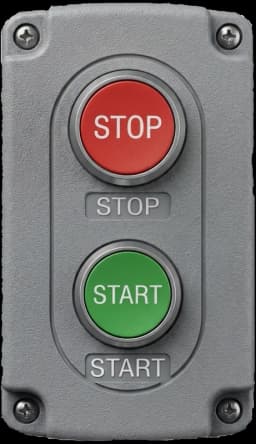
Physical Interface
This arrangement provides three protections that are inherent to the circuit topology, not added by external devices:
Low-voltage protection. Power loss de-energizes the coil. The seal-in opens. When power returns, the motor does not restart — the START button and seal-in are both open. A deliberate START press is required.
Fail-safe stop. The STOP button is NC, wired in series. A broken wire, a failed button spring, or a disconnected terminal has the same effect as pressing STOP — the series path opens and the motor shuts down.
Overload protection. The OL 95-96 contacts are NC, wired in series with the coil. A thermal trip opens them, de-energizing the coil and dropping the motor. The relay must be manually reset before the motor can restart.
OL Contact Placement
The overload relay's 95-96 contact appears somewhere in the series control path, but its position varies by standard:
Return-side (NEMA/JIC): The OL contacts are wired between the coil's A2 terminal and the L2 return. NEMA starters ship with this connection factory-installed — a jumper wire from A2 to 95 and from 96 to L2. This is the convention taught in most North American training programs.
Hot-side (IEC 60204-1): The OL contacts are wired between L1 and the STOP button. The OL is the first device in the control chain, upstream of everything else. This is the IEC machinery safety standard.
Both placements are code-compliant and electrically equivalent — the OL contacts are in series with the coil either way. The circuit functions identically regardless of which side the contacts occupy. For a full comparison of the two conventions, the engineering rationale behind each, and how to identify which one is in front of you when you open a panel, see NEMA vs IEC overload relay placement.
Wiring the Circuit
In the field, every connection begins with lockout/tagout. Verify zero voltage across all terminals with a calibrated meter before touching any conductor. In the motor control simulator, the power supply starts de-energized — but the discipline of verifying before touching is the habit that matters.
The full connection list:
Power circuit (field-wired):
L1to starterL1terminalL2to starterL2terminalL3to starterL3terminal- Starter
T1to motorT1 - Starter
T2to motorT2 - Starter
T3to motorT3
Control circuit (field-wired):
- Starter
L1(control tap) to control station STOP terminal 1 - STOP terminal 2 to START terminal 3
- START terminal 4 to starter terminal
14(connects toA1via factory jumper) - Starter terminal
13(seal-in NO) to START terminal 3 (junction)
Factory-installed (NEMA starters):
- Terminal
14to coilA1(seal-in to coil) - Coil
A2to OL95(coil return through overload) - OL
96toL2(overload return to supply)
On a NEMA starter with factory jumpers in place, the field electrician lands four control wires and six power wires. That is the complete job. For a closer look at each factory jumper — what it does, what happens without it, and how IEC starters differ — see what's already wired inside your motor starter.

Reading is one thing — wiring it yourself is another. Open the interactive trainer and build this circuit from scratch.
You just traced the circuit on paper. Wire it for real -- route every conductor from L1 to T3 in the free motor starter trainer. →Common Mistakes
Forgetting the seal-in. The motor runs only while START is held. The seal-in auxiliary (13-14) must be wired in parallel with the START button — terminal 13 to the STOP/START junction, terminal 14 to A1 (or its factory jumper equivalent).
Wiring STOP as NO. The motor will not start. An NO STOP button is open at rest, which permanently breaks the series path. Pressing START has no effect because the path upstream is already broken. The STOP button must be NC — that is the fail-safe design.
Confusing OL heaters with OL contacts. The heater elements carry motor current in the power circuit. The 95-96 contacts carry coil current in the control circuit. They are on the same device but serve entirely different functions. Heaters go in the power path. Contacts go in the control path.
Missing the return path. The control circuit needs a complete path from the coil back to L2. If A2 has no route to the return conductor — whether through the OL contacts or directly — pressing START produces no response. No hum, no click, nothing. The coil has no return.
What Comes Next
The basic motor starter circuit is the first in a sequence of increasingly complex motor control schemes, each one an extension of the same 3-wire topology:
Control transformer starters separate the control voltage from the motor voltage. A step-down transformer provides 24V or 120V for the control circuit while the motor runs at 208V or 480V. Standard practice at higher voltages and increasingly common at 208V for safety and long control wire runs. Practice this in the control transformer starter trainer.
Jogging circuits add a JOG function — the motor runs only while the JOG button is held, without engaging the seal-in. Requires a control relay or selector switch to isolate the jog path. Two variants: the selector switch jog trainer and the control relay jog trainer.
Reversing starters use two contactors with electrical interlocking to swap two motor phases for direction reversal. The control circuit expands but the underlying 3-wire logic remains. Build one in the reversing hoist trainer.
Frequently asked questions
How do you wire a 3-phase motor starter?
Two circuits, ten field wires on a NEMA starter. The power circuit lands six conductors: L1, L2, L3 from the disconnect to the starter line terminals, and T1, T2, T3 from the starter load terminals to the motor. The control circuit lands four conductors: L1 to STOP terminal 1, STOP terminal 2 to START terminal 3, START terminal 4 to starter terminal 14, and starter terminal 13 back to the STOP/START junction. NEMA factory jumpers handle the coil return through the overload contact.
What is the control circuit path through a motor starter?
From hot to return: **L1 → STOP (NC) → START (NO) → Coil A1 → Coil A2 → OL 95-96 (NC) → L2**. Every device in the chain must be closed for current to reach the coil. STOP is normally closed and passes current at rest, START is normally open and blocks current until pressed, and the OL contacts are normally closed unless the relay has tripped. Press START and current flows through every device.
Where does the seal-in contact go in a motor starter?
Wired in parallel with the START button — terminal 13 of the contactor's auxiliary block to the STOP/START junction, and terminal 14 to coil A1 (which on NEMA starters is reached through a factory jumper from terminal 14 to A1). Both START and the seal-in bridge the same two electrical nodes: the output of the STOP button and the input of the coil. The seal-in closes when the contactor pulls in and holds the coil energized after START is released.
What's the difference between the OL heaters and the OL contacts?
They are on the same device but live in different circuits. The heater elements sit in the power circuit and carry full motor current — they generate heat proportional to the load and trip the bimetallic mechanism on sustained overcurrent. The 95-96 contacts sit in the control circuit and carry only coil current — they open when the relay trips and de-energize the contactor. Heaters protect the motor by sensing; contacts protect the motor by interrupting the coil.
What are the most common mistakes when wiring a motor starter?
Four come up repeatedly. Forgetting the seal-in — the motor only runs while START is held. Wiring STOP as NO — the motor will not start at all because the open NO contact permanently breaks the series path. Confusing OL heaters with OL contacts — heaters belong in the power path, contacts in the control path. Missing the return path — if A2 has no route back to L2, pressing START produces nothing: no hum, no click, no response.