
Open a motor control panel and pull the folded schematic from the document pocket on the inside of the door. The drawing you are looking at is a ladder diagram. It does not show where the wires physically run. It does not show the panel layout or the DIN rail spacing. It shows the logic of the circuit — what controls what, and in what order.
Every motor control circuit you will encounter in the field, from a single-contactor across-the-line starter to a multi-speed reversing drive with interlocking, is documented this way. Reading ladder diagrams is not a supplementary skill. It is the primary skill. The schematic on the panel door is the authoritative record of how the circuit works, and a technician who cannot read it is working from memory or guesswork.
Rails and Rungs
A ladder diagram is drawn between two vertical lines. The left rail is L1, the hot conductor. The right rail is L2, the return conductor. Every horizontal line between L1 and L2 is a rung. Each rung is an independent parallel circuit, supplied by the same source.
On a 208V line-voltage control circuit, both L1 and L2 are ungrounded phases. L2 is not neutral. The term "return" describes the circuit path, not the conductor's grounding status. On a control-transformer circuit — standard practice at 480V installations, common at 208V — the left rail is X1 (the ungrounded secondary conductor) and the right rail is X2 (the grounded secondary conductor). The logic is identical.
Rungs are read top to bottom, left to right. The topmost rung has logical priority — it typically contains the primary control path. Input devices (pushbuttons, selector switches, limit switches, pressure switches) sit on the left side of each rung, adjacent to L1. Output devices (contactor coils, relay coils, indicator lights, solenoids) sit on the right side, adjacent to L2. This arrangement is not arbitrary. It maps directly to the circuit's intent: conditions on the left must be satisfied before the output on the right can energize.
This layout reflects a structure that repeats on every rung: signal, decision, action. The signal is the input device that detects a condition: a pushbutton pressed, a limit switch tripped, a pressure threshold reached. The decision is the series and parallel arrangement of contacts that evaluates whether conditions are met. The action is the output device (coil, solenoid, pilot light) that responds when the decision path is complete. Find the signal, trace the decision, identify the action. That sequence reads any rung on any ladder diagram.
Contacts
Contact symbols represent the inputs and conditions that permit or block current flow through a rung. Two types appear on every ladder diagram.
Normally open (NO): Drawn as two short vertical bars with a gap between them. The gap means the contact is open at rest — no current can pass. In NEMA/JIC notation, this is written ] [. When the contact's actuating device energizes or is actuated, the contact closes and current flows.
Normally closed (NC): Drawn as two short vertical bars with a diagonal line from lower-left to upper-right crossing the gap. The diagonal means the contact is conducting at rest — current passes through it continuously. In NEMA/JIC notation, this is written ]/[. When the actuating device energizes or is actuated, the contact opens and current stops.
The word "normally" is the source of more misunderstanding than any other term in motor control. "Normally" does not mean "during normal operation." It means "at rest" — the state of the contact when the device that controls it is de-energized, unactuated, unpressed, and untripped. A STOP pushbutton is normally closed. Current flows through it continuously during normal running. Pressing STOP opens the contact and breaks the circuit. This seems backwards until you understand the design principle: the resting state of the STOP button is the safe state. If the wire to the STOP button breaks, or the button mechanism fails, the contact opens. The motor stops. This is fail-safe design, and it is the reason every STOP button on every motor control circuit in every industrial facility is wired NC.
The symbols reflect the physical mechanism inside the device. In a normally open contact, a spring holds the movable contact arm away from the stationary contact. The gap in the symbol represents this physical separation. In a normally closed contact, the spring presses the movable arm against the stationary contact. The diagonal in the symbol represents the conducting bridge. When you see a gap, the spring is holding the contact open. When you see the diagonal, the spring is holding it closed.
Normally open is simpler to grasp — a START button is NO, and the motor does nothing until someone presses it. But the NC concept is where technicians build or lose their understanding of ladder diagrams. An overload relay's 95-96 contact is NC. Closed at rest, because no fault exists. When the relay trips on overcurrent, the contact opens, the coil de-energizes, and the motor stops. If you misread the OL contact as NO, the entire circuit's logic inverts in your head.
Coils
A coil symbol represents the output device on a rung — the thing that happens when all the conditions to its left are met. In NEMA/JIC notation, a coil is drawn as a circle or parentheses ( ) with a letter designation inside: M for a motor contactor, CR for a control relay, TR for a timing relay, SOL for a solenoid. IEC notation uses a rectangle instead of a circle. The designation is the same.
Coils are always drawn on the right side of the rung, adjacent to L2. A coil should never appear anywhere else on the rung. If you see two coils in series on a single rung, something is wrong with the drawing — each coil needs full voltage across it to operate reliably, and series coils divide the available voltage.
The letter designation on the coil is the link to every other contact on the diagram that shares that designation. When coil M energizes, every contact labeled M changes state: M-NO contacts close, M-NC contacts open. This relationship is the backbone of ladder diagram logic.
Four Rules
Every ladder diagram follows four rules:
- The diagram shows circuit logic, not physical layout. Component positions on the drawing bear no relation to their positions in the panel.
- Every component is drawn in its de-energized, unactuated resting state.
- The letter designation on a coil links to every contact that shares that designation.
- When a coil energizes, every contact with that designation changes state simultaneously: NO contacts close, NC contacts open.
These rules apply to every ladder diagram, from a single-rung pilot light circuit to a forty-rung multi-speed reversing drive.
Tracing a Rung
The 3-wire motor control circuit is the standard teaching example because it contains every fundamental element: an NC contact, an NO contact, a seal-in branch, a coil, and an overload contact. A single rung encodes start, stop, seal-in memory, and overload protection.
Read the rung from L1 to L2:
L1 → STOP (NC) → junction → START (NO) → junction → Coil M → OL (NC) → L2
Below the main rung, a branch connects the same two junctions through a second path: the M seal-in contact (NO).
At rest, trace the current path. L1 is hot. Current enters the STOP contact — it is NC, so the path continues. Current reaches the junction. Two paths forward exist: through START (NO, open, blocked) and through the M seal-in contact (NO, open, blocked). Current stops. No path exists to the coil. The motor is off.
An operator presses START. The START contact closes. Current flows from L1 through STOP, through the now-closed START contact, through coil M, through the OL contact (NC, closed, no fault), to L2. The coil energizes. The contactor pulls in. The M seal-in contact closes. Current now has a second path around the START button — through the seal-in contact.
The operator releases START. The START contact reopens. Current continues to flow through the seal-in contact. The coil stays energized. The motor keeps running. The circuit has latched.
The operator presses STOP. The STOP contact opens. Both paths — START and seal-in — are downstream of the STOP contact. Opening STOP removes the only supply to the junction, so neither path can carry current to the coil. Current stops. The coil de-energizes. The contactor drops out. The seal-in contact reopens. The motor stops and stays stopped. The circuit has unlatched, and it will not restart until someone presses START again.
This is the mechanism that prevents automatic restart after a power interruption. When power is lost, the coil de-energizes and the seal-in contact opens. When power returns, the circuit is at rest — STOP is closed, but both START and the seal-in contact are open. The motor stays off until an operator deliberately presses START.
In the framework from the Rails and Rungs section: the START button is the signal, the series path through STOP and the parallel path through the seal-in contact form the decision, and coil M is the action.
Instrument: 3-Wire Control Logic
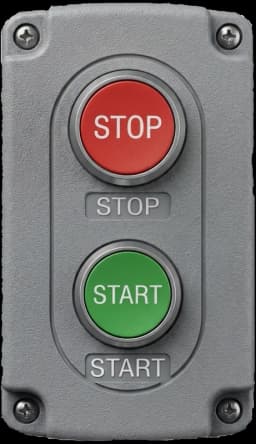
Physical Interface
The 3-wire circuit is covered in full depth in 3-Wire Motor Control Circuit Explained.
Series and Parallel
Series and parallel contact arrangements on a ladder diagram map directly to Boolean logic.
Series contacts = AND. Two contacts in series on a rung means both must be closed for current to reach the coil. If either one is open, the path is broken. The STOP and START contacts on the 3-wire circuit are in series — both must provide a closed path for the coil to energize.
Parallel contacts = OR. Two contacts in parallel (one on the main rung, one on a branch below) means either one can carry current to the coil. The START button and the M seal-in contact are in parallel — either path delivers current to the coil.
These combinations build up. A forward/reverse interlocking circuit places two NC contacts in series with each direction's coil — the forward contactor's NC contact in series with the reverse coil, and vice versa. Both the interlock contact AND the direction pushbutton must be satisfied (AND logic). A multi-station start circuit wires three START buttons in parallel. Any one can start the motor (OR logic). Three STOP buttons wire in series, because any single station must be able to stop it (AND logic applied to the NC path).
Coils are never wired in parallel with each other on the same rung. Each coil gets its own rung. Loads in series on a rung divide voltage and will not operate correctly.
Cross-References
Ladder diagrams use a numbering and cross-referencing system that links coils to their contacts across the entire drawing.
Rungs are numbered sequentially on the left rail — 1, 2, 3, and so on. When a coil appears on a rung, the right side of L2 shows a set of numbers. These are the rung numbers where that coil's contacts appear elsewhere in the diagram.
If coil M is on rung 1 and an M-NO seal-in contact is on rung 1 and an M-NO auxiliary contact is on rung 3 and an M-NC interlock contact is on rung 5, the cross-reference notation to the right of coil M reads: 1, 3, 5. The underlined number indicates a normally-closed contact. Not underlined means normally open.
This system eliminates guesswork. When you see a contact labeled CR2 on rung 7 and need to know what energizes it, scan the cross-references or scan the coil designations until you find the CR2 coil. Its rung tells you what conditions control that relay. The cross-reference numbers tell you everywhere its contacts appear. On a complex diagram with forty rungs, this system is the difference between reading the circuit in minutes and tracing wires for an hour.
Control Circuit vs Power Circuit
The ladder diagram shows the control circuit. It does not show the power circuit.
The power circuit — three-phase supply lines through the contactor's main contacts, through the overload relay heaters, to the motor terminals — is drawn as a separate diagram, typically above or beside the ladder. The power diagram shows L1, L2, and L3 as three vertical lines dropping through NO main contacts (one per phase), through OL heater elements (one per phase), and converging at the motor.
The critical link between the two diagrams is the device designation. When coil M energizes on the control ladder, the three M main contacts on the power diagram close simultaneously. Same device, same letter, two diagrams. The coil on the control rung is the electromagnetic mechanism that pulls the contactor armature in. The main contacts on the power diagram are the load-carrying contacts that the armature physically closes. One magnetic event connects both drawings.
A common early mistake is trying to find the motor on the ladder diagram. The motor does not appear on the ladder. The ladder shows the coil that controls the contactor. The power diagram shows the contactor's main contacts that switch the motor. The OL relay bridges both: its heaters sit in the power circuit (carrying motor current), and its 95-96 NC contact sits in the control circuit (protecting the coil path).
The physical wiring that connects these two diagrams — where each conductor lands and what the field electrician actually installs — is covered in How to Wire a Motor Starter. The conventions that determine where the OL contact sits in the control rung are covered in NEMA vs IEC Overload Relay Placement.
Wire Numbering
Each electrically common point on a ladder diagram receives a wire number. The number changes every time a wire passes through a component. All wire segments connected to the same electrical node share the same number.
On a 3-wire control rung, the wire between L1 and the input side of the STOP button might be numbered 1. The wire between the output side of STOP and the junction is numbered 2. The wire between the junction and the START button input is also 2 — it is the same electrical node. The wire from START output to the coil might be numbered 3. The wire from the coil to OL terminal 95 is numbered 4. From OL terminal 96 to L2 is another number.
NEMA ICS 19 defines standardized wire number ranges: 101-199 for main power conductors, 201-299 for control-voltage conductors, and higher ranges for other voltage levels and special functions. Not every drawing follows these ranges — legacy installations, custom OEM panels, and international equipment may use their own schemes. But the principle is universal: same number means same node.
Wire numbers are what the electrician uses to connect the physical circuit to the logical drawing. The schematic says wire 203 lands on terminal 2 of the STOP button and terminal A1 of the coil. The physical panel has wire 203 — a tagged conductor — running from one terminal to the other, possibly through a terminal block. The wire number is the bridge between the diagram in your hand and the wire in front of you.
Where You Will See Them
The schematic taped or pocketed inside the panel door is a ladder diagram. It is the as-built record of the control circuit. On legacy panels, this is a blueprint or a photocopy of a blueprint. On modern installations, it is a printed sheet generated from AutoCAD Electrical, EPLAN, or SEE Electrical.
Equipment manuals from motor starter manufacturers — Allen-Bradley, Eaton, Siemens, Square D, ABB — include ladder diagrams for every standard configuration. The wiring diagram (showing physical terminal locations and wire routing) is a separate drawing. The ladder diagram shows logic. The wiring diagram shows execution.
Engineering drawing sets for industrial projects include ladder diagrams as part of the electrical package, typically in the E-series sheets. A facility with 200 motors may have a ladder drawing set with hundreds of rungs across dozens of sheets, all cross-referenced to each other.
The ability to pick up a folded schematic, identify L1 and L2, trace a rung from left to right, recognize the contacts and the coil, and understand what the circuit does before touching a single wire — that is what reading a ladder diagram means.

Reading is one thing — wiring it yourself is another. Open the interactive trainer and build this circuit from scratch.
Practice reading and wiring a 3-wire motor control ladder diagram →Frequently asked questions
What does normally open mean in a ladder diagram?
Normally open means the contact is open when its actuating device is at rest — de-energized, unpressed, unactuated. It does not mean the contact is currently open or open during normal operation. A START pushbutton is normally open: the contact is open until someone presses the button. A contactor auxiliary contact labeled NO is open until the contactor coil energizes. The word normally refers exclusively to the resting, de-energized state of the device that controls the contact.
What is the difference between a ladder diagram and a wiring diagram?
A ladder diagram shows the logical function of the circuit — what controls what, in what order, and under what conditions. It does not show physical wire routing, terminal locations, or panel layout. A wiring diagram shows the physical connections: which terminal each wire lands on, how conductors route through the enclosure, and where components are physically mounted. Ladder diagrams are read to understand circuit logic. Wiring diagrams are read to make physical connections. Both appear in equipment documentation, and the wire numbers link them together.
How do you trace current flow through a ladder diagram rung?
Start at L1 on the left rail and follow the rung to the right, passing through each device in sequence. At each contact, determine whether it is open or closed based on the current state of its actuating device. If all contacts in a series path are closed, current reaches the coil on the right side. If any contact in the series path is open, current is blocked at that point. For parallel branches, check each path independently — current flows through whichever branch has all contacts closed. The path ends at L2 on the right rail.
What do L1 and L2 mean in a motor control ladder diagram?
L1 is the hot conductor and forms the left rail of the ladder diagram. L2 is the return conductor and forms the right rail. On a 208V line-voltage control circuit, both L1 and L2 are ungrounded phases — L2 is not neutral. On a control transformer circuit, the left rail is X1 (ungrounded secondary) and the right rail is X2 (grounded secondary). The two rails provide the voltage source for every rung on the diagram, and each rung is an independent parallel circuit connected between them.
Why is it called a ladder diagram?
The name comes from the visual layout. The two vertical rails (L1 and L2) look like the side rails of a ladder, and the horizontal circuit paths between them look like the rungs. Each rung represents an independent parallel circuit connected between the same two power rails.
What is the difference between a control circuit and a power circuit?
The control circuit is the logic layer — pushbuttons, selector switches, relay contacts, coils, and indicator lights drawn as horizontal rungs on the ladder diagram. The power circuit carries the load current — three-phase supply lines through the contactor main contacts and overload relay heaters to the motor terminals, drawn as a separate three-line diagram. The device designation links them: when coil M energizes on the control ladder, the three M main contacts on the power diagram close simultaneously.