
A PLC, a programmable logic controller, reads its inputs, runs a program and switches its outputs, over and over. Pushbuttons and sensors are wired to its inputs. Starter coils and lamps are wired to its outputs. The program decides which outputs turn on for the inputs it sees. You do not need any experience to follow this.
A PLR, a programmable logic relay, is the small end of the same idea, with fewer inputs and outputs and a lower price. That makes it a good place to start, and it is the one on this bench.
I started on a programmable relay myself, after practicing in the garage on TECO relays bought on eBay, with TECO's free software and some help from Jim Pytel's PLC videos, which feature TECO relays. A lot of my small-business clients had small control jobs, and a relay like this one handled them at a price that was approachable.
Turn the power on and press START. The motor runs, and the rung in the program strip lights.
Wiring
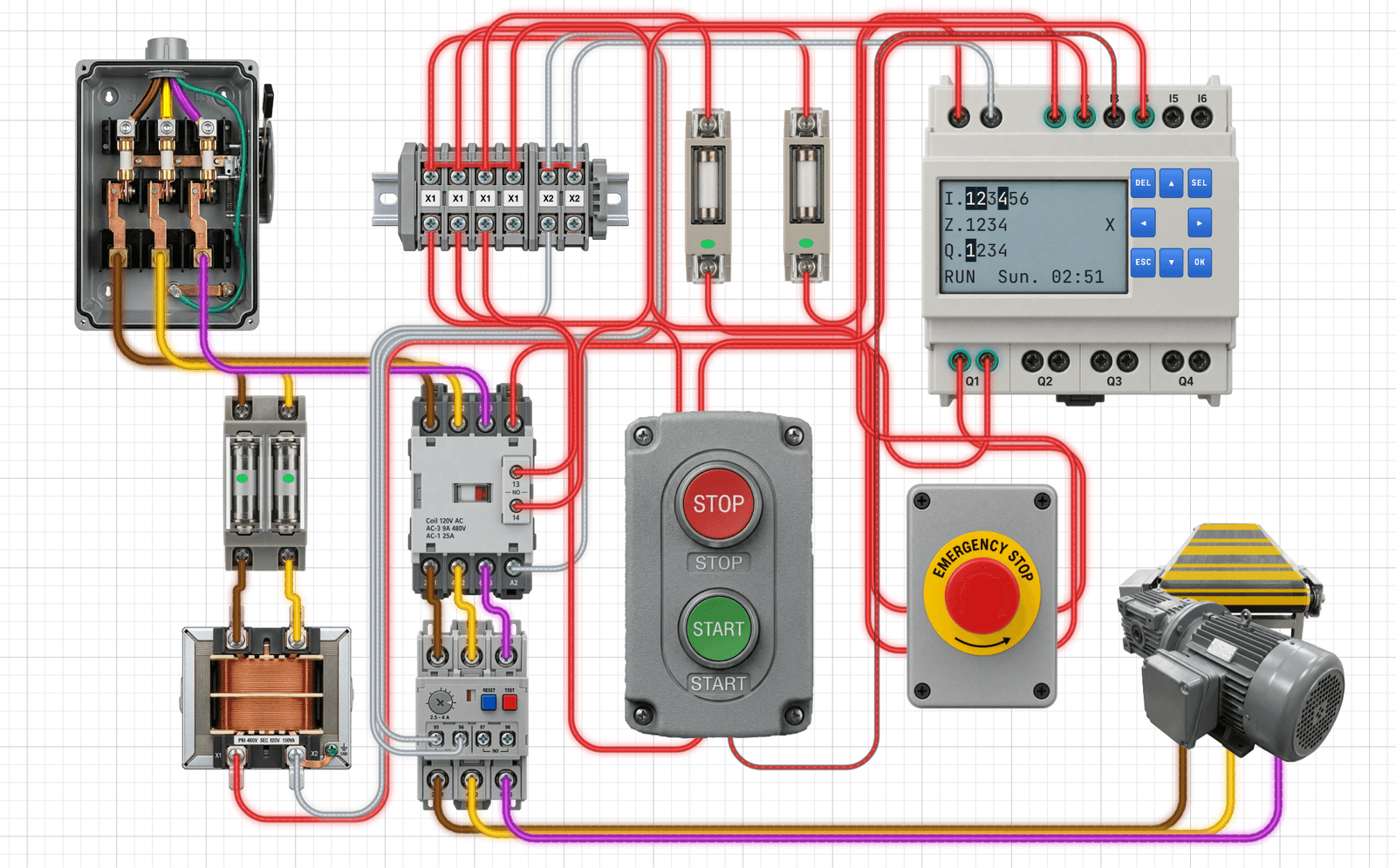
START, STOP and the e-stop are wired to the relay's inputs. The starter's coil is wired to an output, and that output is a relay contact switching the starter's 120 V coil. A control transformer steps the 480 V supply down to 120 V. When the coil is energized, the starter pulls in, and its main contacts connect the motor to 480 V through the overload relay.
Some of this circuit's logic is not in the program. The coil-loop fuse, a contact on the e-stop and the overload's normally closed contact (95-96) are wired in series with the coil, one after another, so any one of them opening drops the starter whatever the program is doing. The relay's supply and the transformer's primary have their own fuses. The e-stop has a second contact wired to an input, so the program knows it has been pressed.
Press the e-stop and the motor stops. On this bench you press it again to reset it, where a real one may reset with a twist or a pull. The e-stop is wired so it does not depend on the relay.
Clever ladder logic can look like magic in its elegance and reliability, but we should not depend on the program alone for emergency stopping.
Program
This program was written on a PC (or a VM if you are allergic to Windows) and sent to the relay over a cable from the computer. The relay has two modes, RUN and STOP. In RUN it reads its inputs, solves the program over and over and operates your circuit. In STOP mode the program does not run, and STOP is also the mode the relay is in after a program is downloaded to it. Great question! Yes, the mode setting does survive a power loss on the SG2 and many other relays and PLCs. That is to say, when power is lost or the equipment is powered down, we don't need to select RUN by hand on the relay's keypad each time.
The program strip shows the rung, read left to right: the e-stop (I01), then START (I03) with I04 on the branch under it, then STOP (I02), then the output Q01. When every contact along it is true, Q01 turns on.
The STOP button is wired normally closed, meaning its contact is closed until you press it. So its input (I02) is on at rest, and in the program it is an ordinary normally open contact that stays true until STOP is pressed. A pressed STOP or a broken wire turns the input off and drops the rung. Press START and STOP and watch the rung in the program strip go true and false.
Let go of START and the motor keeps running, so something else is holding the rung on.
Seal-in
On a hardwired starter, the seal-in uses the starter's auxiliary contact (usually 13-14), wired in parallel with START so the coil holds itself in. You can wire that one yourself in the basic motor starter simulator, with no account needed. Here the auxiliary contact is wired to input I04 instead, and START is not wired in parallel with it. The branch under START (I03) in the program reads I04.
A program could also hold the rung on its own output, Q01. If it did, replacing a blown coil-loop fuse with the circuit energized would start the motor again by itself, because the relay runs on its own fuse and keeps holding Q01. Changing that fuse hot is ridiculous to imagine. However, people do ridiculous things when they don't know what they are doing.
Start the motor, then trip the overload with its red TEST button and reset it with the blue RESET. The starter dropped, so its auxiliary contact opened and the program let go. The motor stays off until you press START. If Q01 held the branch under START instead, the motor would start again as soon as the overload was reset, without anyone pressing START.
The auxiliary contact reports the status of the starter, not the motor. A closed starter says nothing about whether the shaft is turning. It tells the program whether the starter pulled in. If the coil-loop fuse, the e-stop or the overload drops the starter, the contact opens, the program sees it and lets go of the rung.
Where to practice
The PLR module takes you through wiring this circuit and writing its program from scratch, and its later explorations build the seal on the starter's auxiliary contact. It is a Pro module. Our Sandbox, also Pro, lets you build circuits of your own around a PLR or other components, save and share them, and experiment. Know another way to hold this rung? Build it there and see what it does.
Reading is one thing; wiring it yourself is another. Open the interactive trainer and build this circuit from scratch.
Wire and program this circuit from scratch in the PLR module (Pro) →For a relay of your own at home, the TECO SG2 is an affordable PLR, and its programming software is a free download from FactoryMation. In November 2026 the relay, the SG2-10HR-A, cost about $185 from a US distributor, and the cable that carries a program from a PC, the SG2-ULINK, which TECO lists as a USB programming cable, cost about $60, before shipping and tax. These items can usually be found on eBay as well. A fuse and holder for its supply, pushbuttons and lamps add to that. The SG2-10HR-A runs on 100 to 240 V AC, and its inputs are at line voltage too.
There are many videos and pages online about building a PLC trainer of your own. My advice is to keep it simple at first, with a few pilot lights or similar, but be sure to find your own way. No one else will do it for you.
If you would rather start on a small PLC, AutomationDirect's CLICK C0-00DR-D cost $133 in November 2026, before shipping and tax. Its 6 outputs are relay contacts rated 1 A each, at up to 240 V AC. Its 8 inputs take 24 V DC, and the PLC itself runs on 24 V DC, so it needs a 24 V power supply. Neither the power supply nor the programming cable is in the box. AutomationDirect's own supply cost $73 and its USB cable $56, which brings the set to about $260 before shipping and tax. A fuse for the supply, pushbuttons and lamps add to that. Its programming software is free, and the download page asks for your email address.
Electrical work of any sort is to be done by a qualified, competent person.
Frequently asked questions
What is a PLC?
A PLC, a programmable logic controller, reads its inputs, runs a program and switches its outputs, over and over. Pushbuttons and sensors are wired to its inputs. Starter coils and lamps are wired to its outputs.
What is a PLR?
A PLR, a programmable logic relay, is the small end of the same idea as a PLC, with fewer inputs and outputs and a lower price.
Should an e-stop depend on the program?
Not on a controller without a safety rating, and the manual for the TECO SG2 used here gives it none. On this bench the e-stop's contact is wired in series with the starter coil, so the motor stops whatever the program is doing. A second contact goes to an input so the program knows too.
Why does the motor stay off after an overload reset?
The program's seal-in reads the starter's auxiliary contact, which opens when the starter drops. After the trip and the reset, nothing holds the rung, so the motor waits for START.
Can I practice PLC programming without buying hardware?
Yes. The PLR module and the Sandbox on this site let you wire and program a PLR in your browser. Both take a Pro account.
What do I need to practice on hardware of my own?
For the TECO SG2, the programming software is a free download. The relay, the SG2-ULINK cable, a fuse and holder for its supply, pushbuttons and lamps are bought. The SG2-10HR-A runs on 100 to 240 V AC, and its inputs are at line voltage too. Electrical work of any sort is to be done by a qualified, competent person.